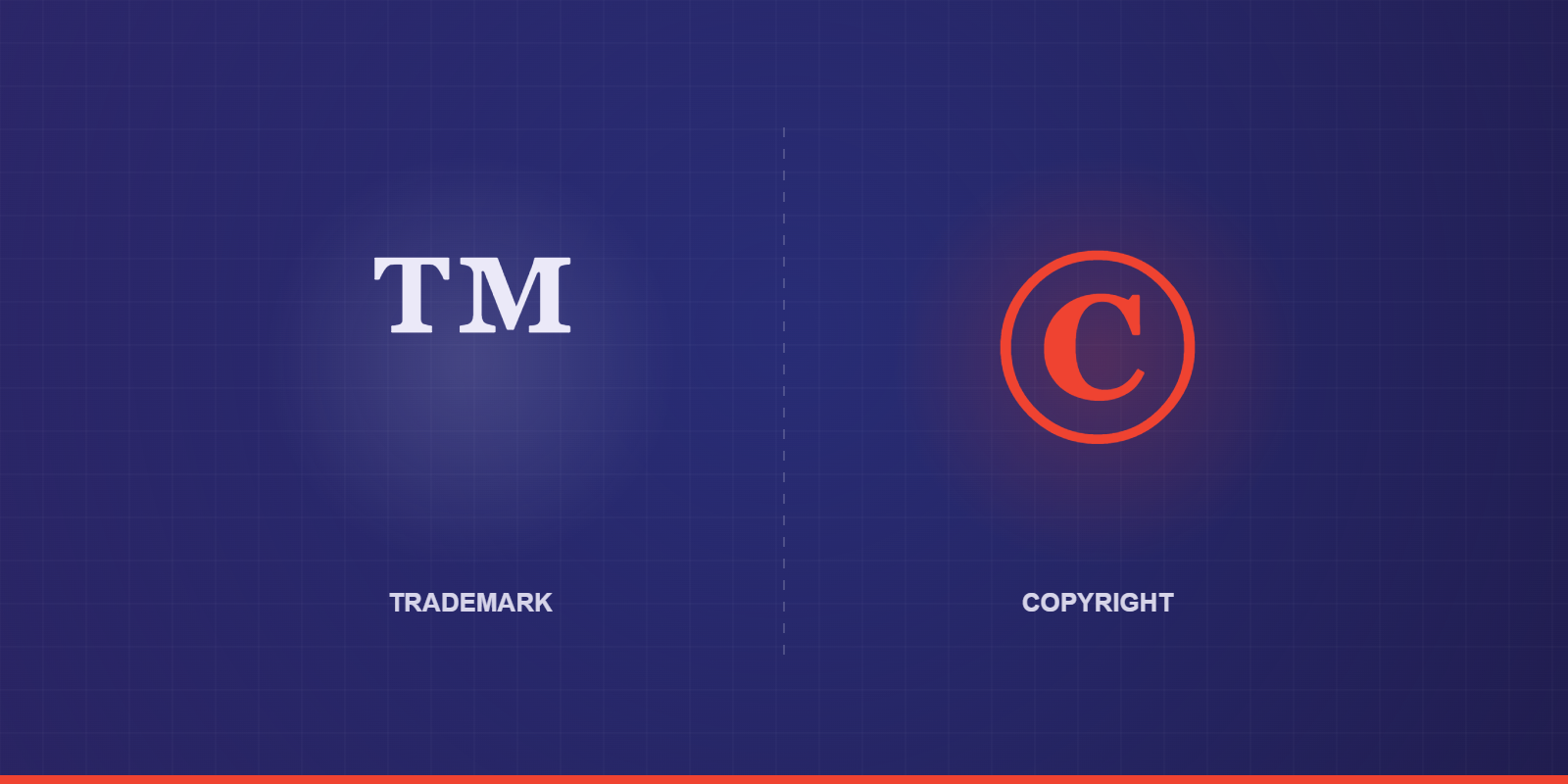
Confused about the difference? If the terms copyright and trademark trip you up, you are not alone.
They both sound important, and the initial inclination may be to use them interchangeably — but they are very different types of intellectual property. Yes, "property." Someone (or some company) owns the rights to the intellectual property.
Trademark
A trademark is a word, phrase, symbol, or design — or a combination of those — that identifies and distinguishes the source of a particular product or service. When you see the Nike swoosh, you know the product (the sneaker, the sweatshirt, the cap) carries a certain quality, you know its source (the Nike company), and you know it's different from products bearing the leaping cougar (Puma) — also high quality, but different. The swoosh and the leaping cougar are trademarks. So are the words "Nike" and "Puma." (The artwork of the swoosh is protected by copyright — but that's the next section; the swoosh itself is protected by trademark.)
To obtain a trademark, you need to be using — or plan to use — your mark in association with your product or service in interstate commerce (transactions that cross state boundaries or involve more than one state). Selling your brand of lemonade in your neighborhood wouldn't qualify. To formally register, you apply to the United States Patent and Trademark Office (uspto.gov). If the mark matters to your business, it is wise to register it. The process may seem simple, but the consequences of error are many — it is always recommended to obtain professional legal advice when registering a trademark.
Copyright
Copyright protects "original works of authorship" — artwork, music, literary works, dramatic works, and certain other creative works, both published and unpublished. To be capable of copyright protection, the work must be original and in tangible form. So the original music playing in your head isn't protected until you express it — by writing it out (notation/sheet music) or recording it (each a tangible form).
The 1976 Copyright Act generally gives the owner a bundle of exclusive rights: to reproduce the work, to prepare derivative works, to distribute copies, and to perform or display the work publicly.
While copyright protection exists the moment you put your original work into tangible form, you would be wise to register it with the United States Copyright Office (copyright.gov) — registration perfects your copyright ownership in the work.
Importantly, ideas are not protected by copyright; only the expression of an idea is. Copyright protects the form of expression rather than the subject matter. Say you have an idea for a play about two youths from opposing families who fall madly, irrationally in love but end up eternally separated by death. The idea isn't protected — but develop and fully express it, with characters, context, and content in tangible form, and you may arrive at something like West Side Story, which is protected.
Another example: your idea to create an artwork of a bowl of fruit isn't protected, but your expression of it — your painted canvas of a wooden bowl with apples, pears, and grapes on a green-clothed table — is. You'd own the copyright to your painting; but I could assemble similar fruit in a similar way, paint that still life, and own the copyright in my expression of it.
A note of caution: while these examples may seem simple, assessing copyright and copyright infringement is not. This is an introduction to a vast and intricate body of law. But now you know two important things — trademark is not the same as copyright, and ideas, in and of themselves, are not protected by copyright.
The take-aways
- Trademark protects words, phrases, and logos associated with a particular business, serving to identify the source of its goods or services. To obtain trademark rights, the business must be engaging in interstate commerce with that product or service.
- Copyright protects original works of authorship fixed in a tangible form of expression — images (art, photographs, graphic design, drawings), songs (music, lyrics, and sound recordings), literary works, other written works, audio/visual works (film, television, video), and other performance arts.
- Both are sometimes obtained for the same project. When a business uses a television commercial to introduce a new product and slogan, it will want to protect the slogan by registering it as a trademark, and make sure it holds the copyright to the advertisement's text, graphics, and audio/visual work.
 Rosemarie Tully, P.C. — counsel to the creative